Guidelines

There are all kinds of ways to make guidelines for calligraphy. Here are some of the ways I do it:

  1. A Word document. This downloadable Word document prints landscape on a letter-size sheet of paper − x-height of 10 points (a little larger than 1/8″) with a leading of 36 points (about 7/8″) and 35º slant lines. The slant lines are in the header/footer area.
  2. An InDesign document, which provides more opportunity fine-tuned guidelines. Here is a downloadable PDF from an InDesign document which has many layers of guidelines − slant lines and regular − that I can turn on and off for a variety of combinations. I could have multiple columns, or a shape that breaks up the text, or other complications that don’t work so well in Word.
  3. I like manually inked guidelines too, especially for large pieces. I use a lining guide, T-square and slantboard for these. John Neal provides instructions for using a lining guide here.

If you don’t want to make your own, you can generate some online at several websites:

I used to use Calli-Graphic, a computer app, but it seems to be defunct.

Posted in something else | Leave a comment

2013-04-22 pointed pen

Posted in lettering | Leave a comment

Pecha Kucha presention

  • Writing is magic. We know this. That we can take a stick or a feather or a can of spray paint and make marks that stand for an idea that some future viewer may understand: that’s magic.

    Writing is magic. We know this. That we can take a stick or a feather or a can of spray paint and make marks that stand for an idea that some future viewer may understand: that’s magic.

  • That said, when I tell some people I am a calligrapher, I can practically see Aunt Agatha’s spidery black writing in a thought bubble over their heads. Everybody knows an Aunt Agatha: she never married, but at least she had her calligraphy. Image smudged to protect Aunt Agatha.

    That said, when I tell some people I am a calligrapher, I can practically see Aunt Agatha’s spidery black writing in a thought bubble over their heads. Everybody knows an Aunt Agatha: she never married, but at least she had her calligraphy. Image smudged to protect Aunt Agatha.

  • But calligraphy is so much more than this. Until the invention of the printing press, calligraphy was IT. Everything was written digitally, that is, with the digits of the hand. Marks were scraped into wax tablets, inked onto papyrus, animal skins, and then paper.

    But calligraphy is so much more than this. Until the invention of the printing press, calligraphy was IT. Everything was written digitally, that is, with the digits of the hand. Marks were scraped into wax tablets, inked onto papyrus, animal skins, and then paper.

  • The Carolingian hand, developed in Charlemagne’s time to facilitate unification and communication within his empire, carries the basic forms of most of our lower-case letters. This page from a Latin Gospel was produced at Tours in the early part of the 9th century.

    The Carolingian hand, developed in Charlemagne’s time to facilitate unification and communication within his empire, carries the basic forms of most of our lower-case letters. This page from a Latin Gospel was produced at Tours in the early part of the 9th century.

  • Even stone-cut letters followed the brush strokes of handmade letters. Hand lettering is a record of a performance, and even the untutored eye sees evidence of the gesture and tool that create the letter forms.

    Even stone-cut letters followed the brush strokes of handmade letters. Hand lettering is a record of a performance, and even the untutored eye sees evidence of the gesture and tool that create the letter forms.

  • As time passed, scribes worked to fit more and more words on the expensive parchment. Letters became compressed, eventually becoming the blackletter style we now associate with Germans and bikers.

    As time passed, scribes worked to fit more and more words on the expensive parchment. Letters became compressed, eventually becoming the blackletter style we now associate with Germans and bikers.

  • The first printing presses mimicked the letterforms made by quills, but as time passed, the tools and materials had their effect on the form: type fonts became less gestural and more constructed. The type in the first Gutenberg bible is a far cry from today’s ubiquitous Helvetica typeface.

    The first printing presses mimicked the letterforms made by quills, but as time passed, the tools and materials had their effect on the form: type fonts became less gestural and more constructed. The type in the first Gutenberg bible is a far cry from today’s ubiquitous Helvetica typeface.

  • At the height of modern design, typography and calligraphy were sharply divided. The Helvetica “a”, at left, was designed for maximum legibility, largely hiding its method of construction. The “a” on the right, by contrast, was made with a pack of toothpicks.

    At the height of modern design, typography and calligraphy were sharply divided. The Helvetica “a”, at left, was designed for maximum legibility, largely hiding its method of construction. The “a” on the right, by contrast, was made with a pack of toothpicks.

  • Now that so much of visual design is created digitally, that is, with pixels and Bezier curves, we evidently hunger for the non-digital look. Books and articles abound on the subject of the handmade in graphic design.

    Now that so much of visual design is created digitally, that is, with pixels and Bezier curves, we evidently hunger for the non-digital look. Books and articles abound on the subject of the handmade in graphic design.

  • Typography and calligraphy are still intertwined. In 1998, the monks of St. John’s Abbey and University commissioned an illuminated, hand-lettered Bible. Consisting of nearly 1,150 vellum pages and 160+ illustrations, it was completed in May 2011.

    Typography and calligraphy are still intertwined. In 1998, the monks of St. John’s Abbey and University commissioned an illuminated, hand-lettered Bible. Consisting of nearly 1,150 vellum pages and 160+ illustrations, it was completed in May 2011.

  • Donald Jackson has led the scriptorium of more than a dozen artists. He created a text hand that was made into a font which was used to typeset each page. These typeset pages were patterns for the calligraphers who hand lettered the text onto calfskin pages, using quills and antique stick inks.

    Donald Jackson has led the scriptorium of more than a dozen artists. He created a text hand that was made into a font which was used to typeset each page. These typeset pages were patterns for the calligraphers who hand lettered the text onto calfskin pages, using quills and antique stick inks.

  • Donald Jackson has led the scriptorium of more than a dozen artists. He created a text hand that was made into a font which was used to typeset each page. These typeset pages were patterns for the calligraphers who hand lettered the text onto calfskin pages, using quills and antique stick inks.

    Donald Jackson has led the scriptorium of more than a dozen artists. He created a text hand that was made into a font which was used to typeset each page. These typeset pages were patterns for the calligraphers who hand lettered the text onto calfskin pages, using quills and antique stick inks.

  • In my own work I use digital programs both as tools of creation and to prepare work for production. Here are camera-ready invitations, scanned and digitally centered (smudged for privacy). Some printers require a JPG; others require a vector file.

    In my own work I use digital programs both as tools of creation and to prepare work for production. Here are camera-ready invitations, scanned and digitally centered (smudged for privacy). Some printers require a JPG; others require a vector file.

  • This was an amusing project. Although it looks like a medieval vellum manuscript page, it is actually a piece of architectural drafting film, inkjet printed and trimmed. I even cut out the holes in the parchment image.

    This was an amusing project. Although it looks like a medieval vellum manuscript page, it is actually a piece of architectural drafting film, inkjet printed and trimmed. I even cut out the holes in the parchment image.

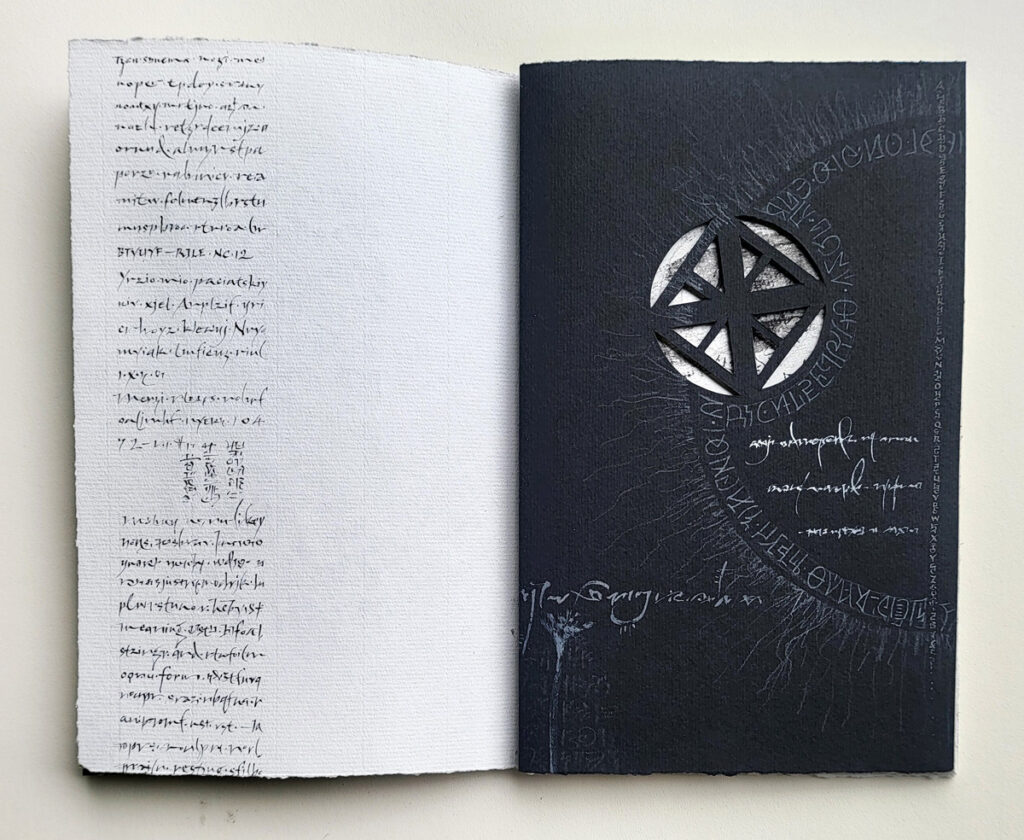
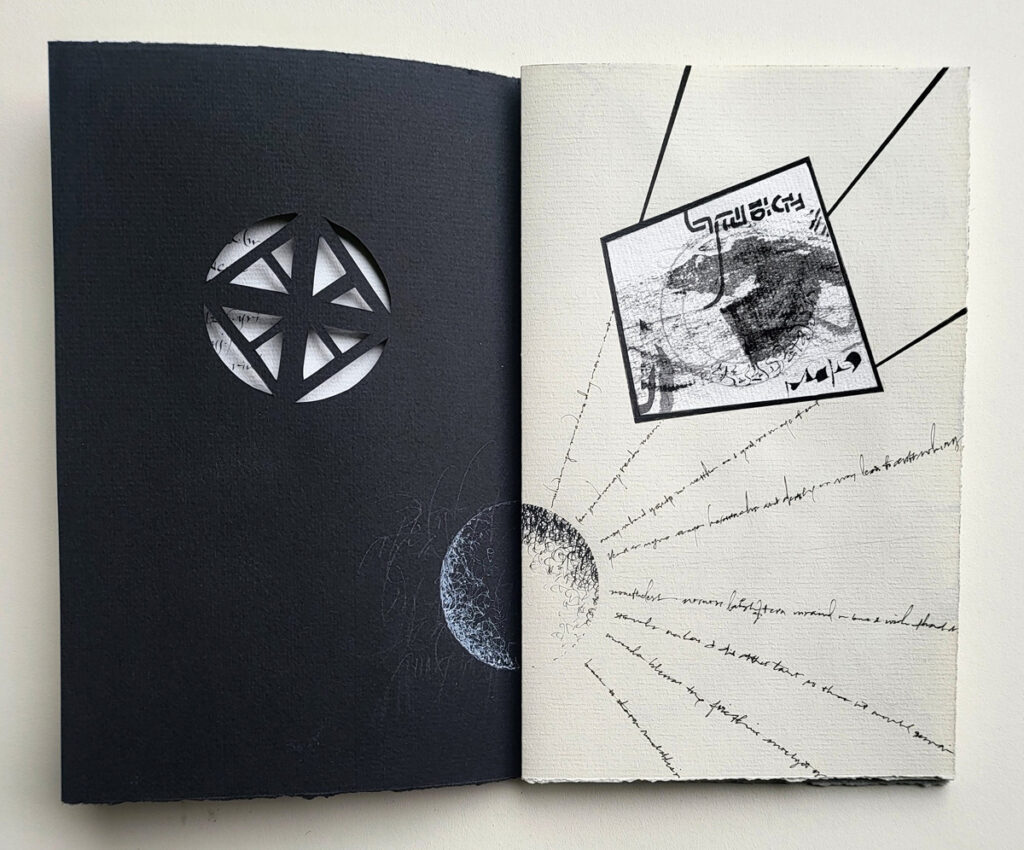
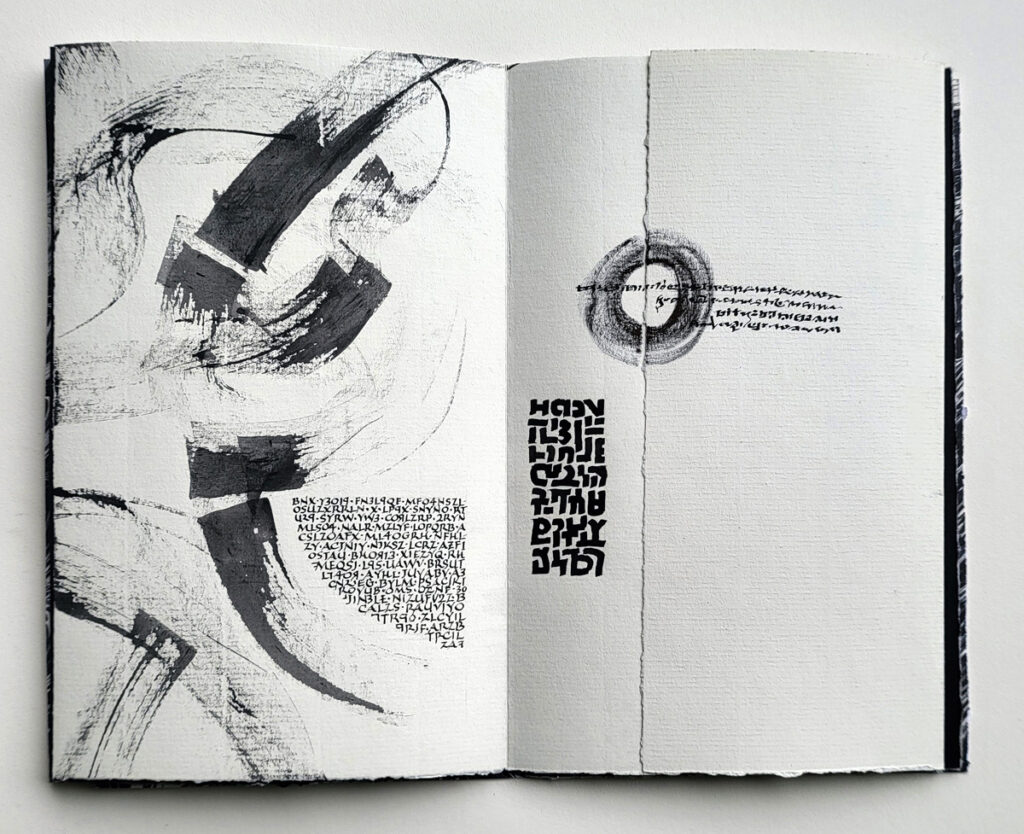
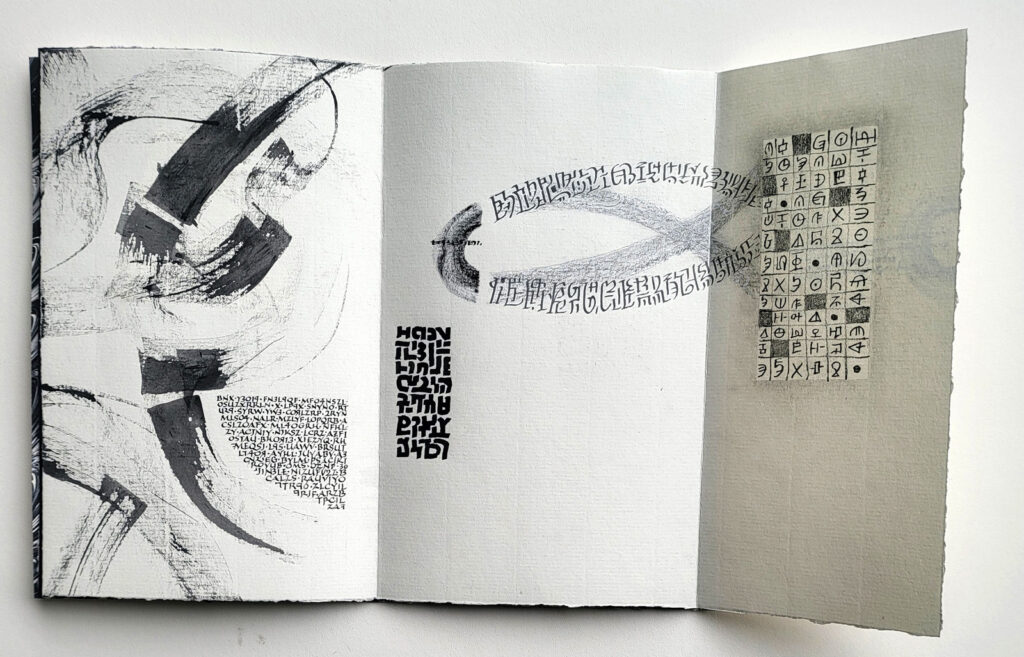
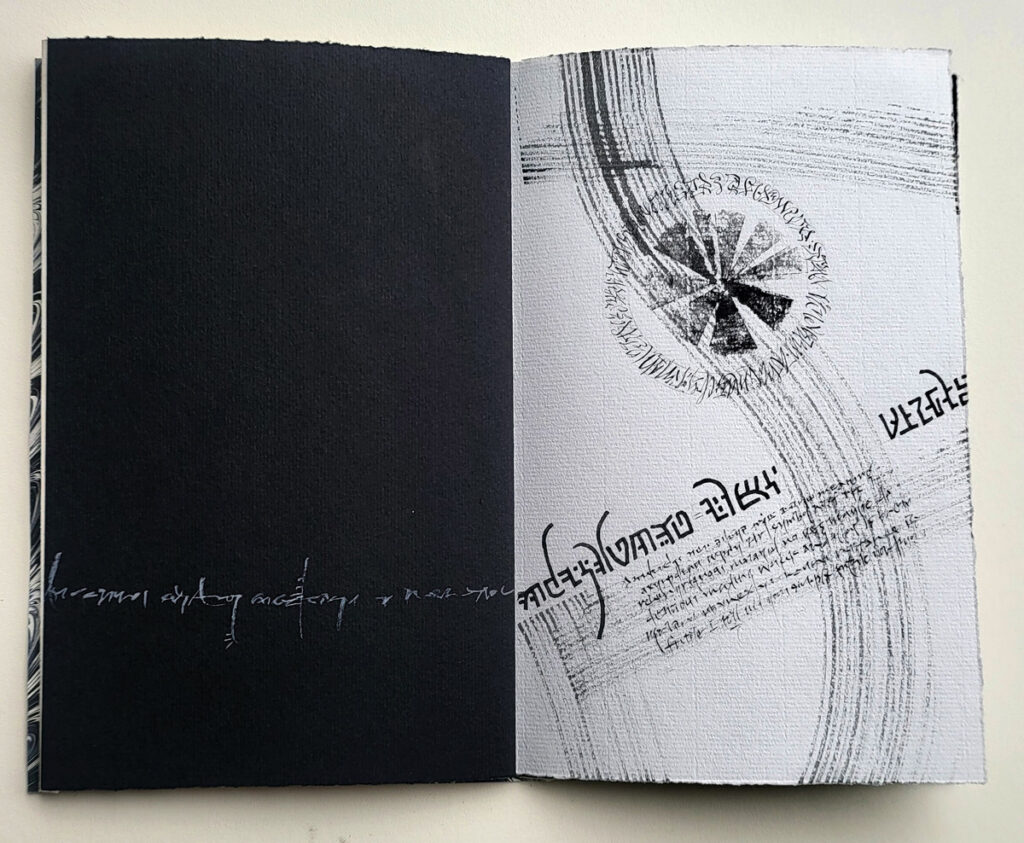
  • Calligraphy is one of the book arts. Three of the four books shown here were commissions. Two on the left were for wedding anniversaries. The top right was a rejected design for a graduation gift. The bottom right book is an artist’s book.

    Calligraphy is one of the book arts. Three of the four books shown here were commissions. Two on the left were for wedding anniversaries. The top right was a rejected design for a graduation gift. The bottom right book is an artist’s book.

  • This is a logo for a children’s summer camp. The lettering and illustration were made with one pen, and this helps to hold the 3 disparate parts of the logo together.

    This is a logo for a children’s summer camp. The lettering and illustration were made with one pen, and this helps to hold the 3 disparate parts of the logo together.

  • Personal projects are my favorite. Here is an image of the mosaic floor of the 6th century synagogue at Beit Alpha in Israel. You see the Greek influence: signs of the zodiac surround the Sun chariot. This image forms the basis of the piece in the next slide.

    Personal projects are my favorite. Here is an image of the mosaic floor of the 6th century synagogue at Beit Alpha in Israel. You see the Greek influence: signs of the zodiac surround the Sun chariot. This image forms the basis of the piece in the next slide.

  • This commemorates a trip to Israel which included Beit Alpha. I replaced the signs of the zodiac with names and symbols of members of our group. Woven in a Croatian interlace are three strands of words listing the places we visited.

    This commemorates a trip to Israel which included Beit Alpha. I replaced the signs of the zodiac with names and symbols of members of our group. Woven in a Croatian interlace are three strands of words listing the places we visited.

  • Besides the sheer joy of mark-making, it’s this discipline of turning over the meanings of words, thinking about multiple meanings and their connections, and making the response gesturally that is so absorbing. It’s a valued antidote to the Twitter-paced deluge of words we encounter every day.

    Besides the sheer joy of mark-making, it’s this discipline of turning over the meanings of words, thinking about multiple meanings and their connections, and making the response gesturally that is so absorbing. It’s a valued antidote to the Twitter-paced deluge of words we encounter every day.

Posted in something else | Leave a comment

The completed certificate

… from earlier this year. I had posted a snippet of it at the time.

Posted in something else | Leave a comment

Envelope Exchange – August 2011

I’ve been busy on the book commission, but took a few minutes to do my envelope for the year-long 2011 Envelope Exchange. I’ve been spending a lot of time lately with my Epson wide-format new inkjet printer, and I carried that experimentation over to this envelope. (As usual, click on the image to see it at a larger size.)

These are the layers on this #10 Strathmore Laid envelope:

  1. Inkjet-print of a scan of some painting on Arches Text Wove.
  2. A layer of Utrecht Workable Spray Fixative.
  3. The name in Dr. Martin’s Iridescent calligraphy gold ink, shaded in FW Antelope acrylic ink(#2½ Mitchell nib and Principality pointed nib).
  4. The address in the same FW Antelope, with #4 Mitchell nib.
  5. Flowers with #3½ and #4 nibs.
I chose the stamp after I did the envelope. I’m surprised at how well they go together.
Posted in envelopes, exchanges, lettering, metallic inks | Leave a comment

Designer Bookbinders of America

Designer Bookbinders of America — what a wonderful new organization and website showcasing excellence in designer bookbinding!

Posted in artist books | Tagged , , | Leave a comment

Birthday cards


These are currently sitting in General Delivery in a small town in North Carolina. The birthdays are Friday and Saturday, but I bet the birthday boy and birthday girl don’t see this before they pick up their birthday cards.

Each of these quotations are very apt for two of the youngest seniors I know.

Watercolor, gouache, Dr. Martin’s Bleedproof White, pastels — on Arches Text Wove.

Posted in lettering | Tagged | Leave a comment

Here’s a new post

… just for my daughter, who thought the dates were wrong on my blog. They aren’t. It’s just been so long since I posted anything …

Posted in something else | Leave a comment

A birthday card

I’m enjoying playing with these alcohol inks and stencils that Martha Lever has been showing on her blog. Click on the image for full-size view.

Made for the most stylish birthday girl I know.

Posted in something else | 1 Comment

Even though it’s been on the Internet for 2 years, I’ve not seen this video of Hermann Zapf until today.

The Art of Hermann Zapf from Johnny Dib on Vimeo.

It must have been filmed 40+ years ago. That paper is luscious, probably handmade. And his pen renditions of type are amazing.

Seen on It’s Nice That.

Posted in calligraphers, typography | Leave a comment