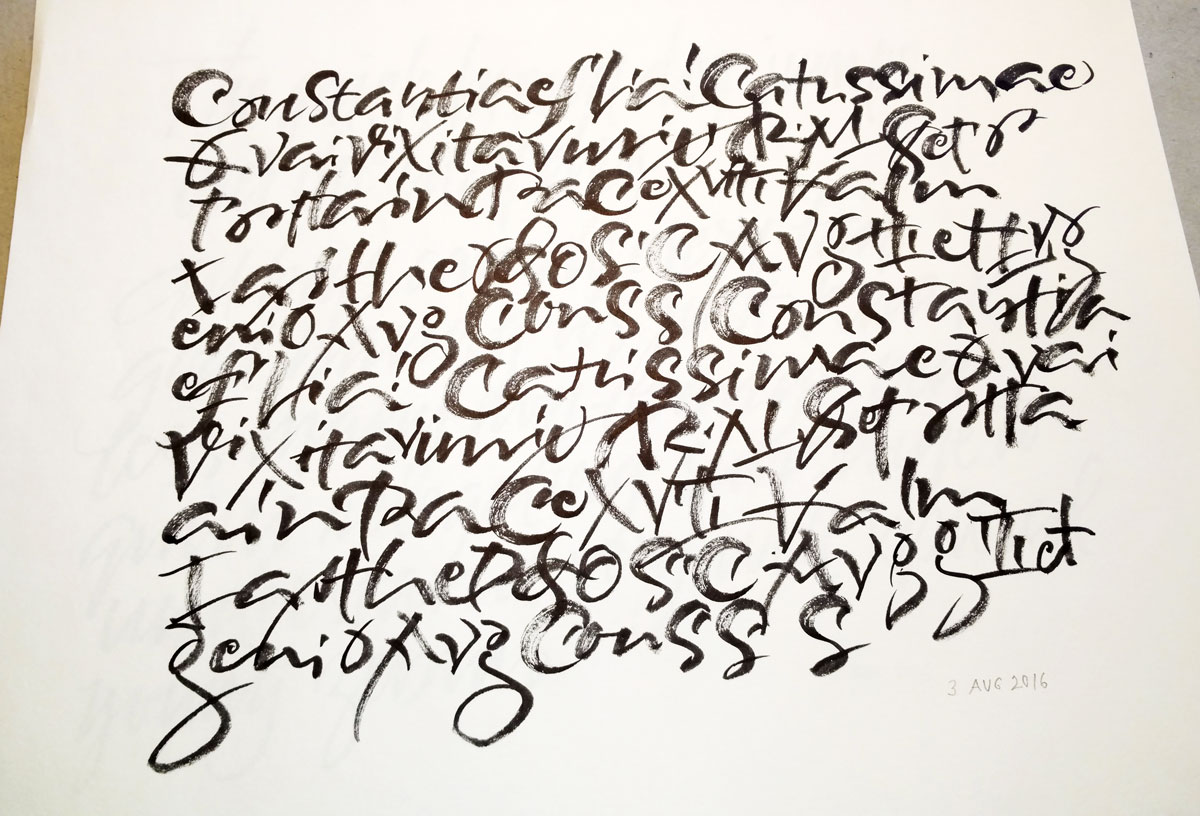
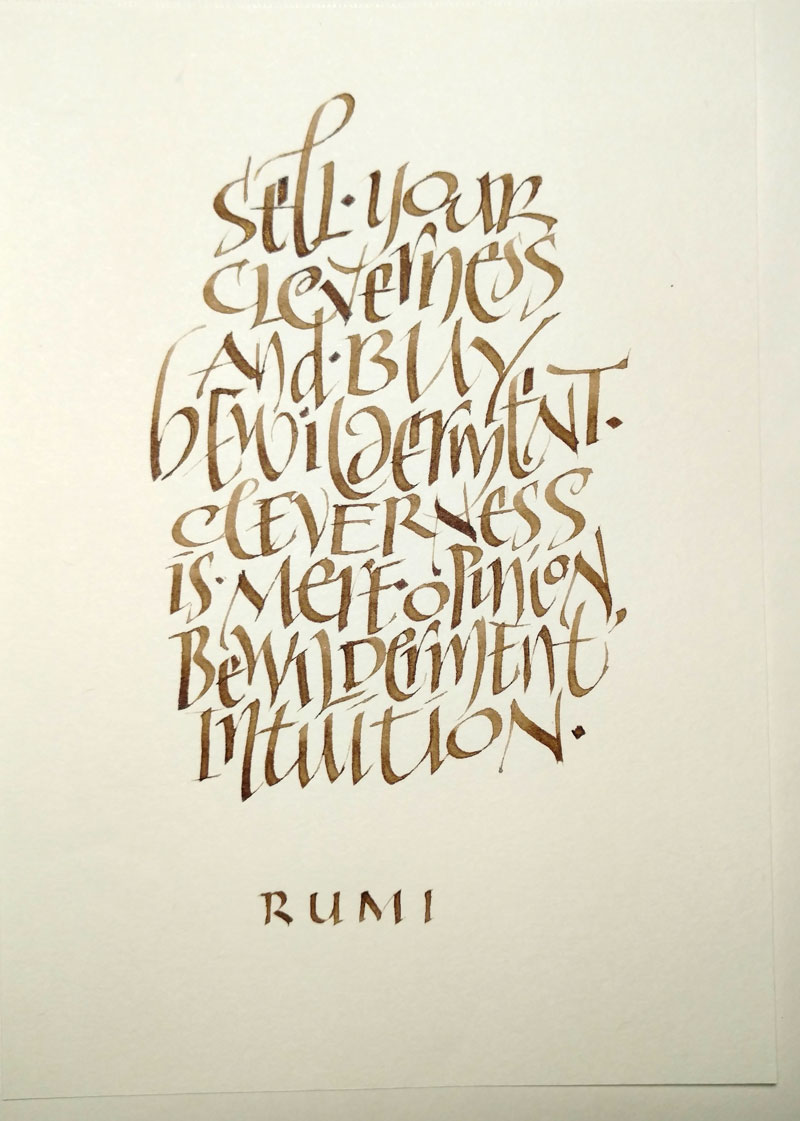
I’m finishing up a small set of manuscript books begun last year. I still had a couple of text blocks to do, and this sheet was done to get back into the space of these letters. Although the book lettering is being done with Speedball B series nibs, I used a brush pen for this sheet, and it was so enjoyable I rather wish I had done the series with a brush.
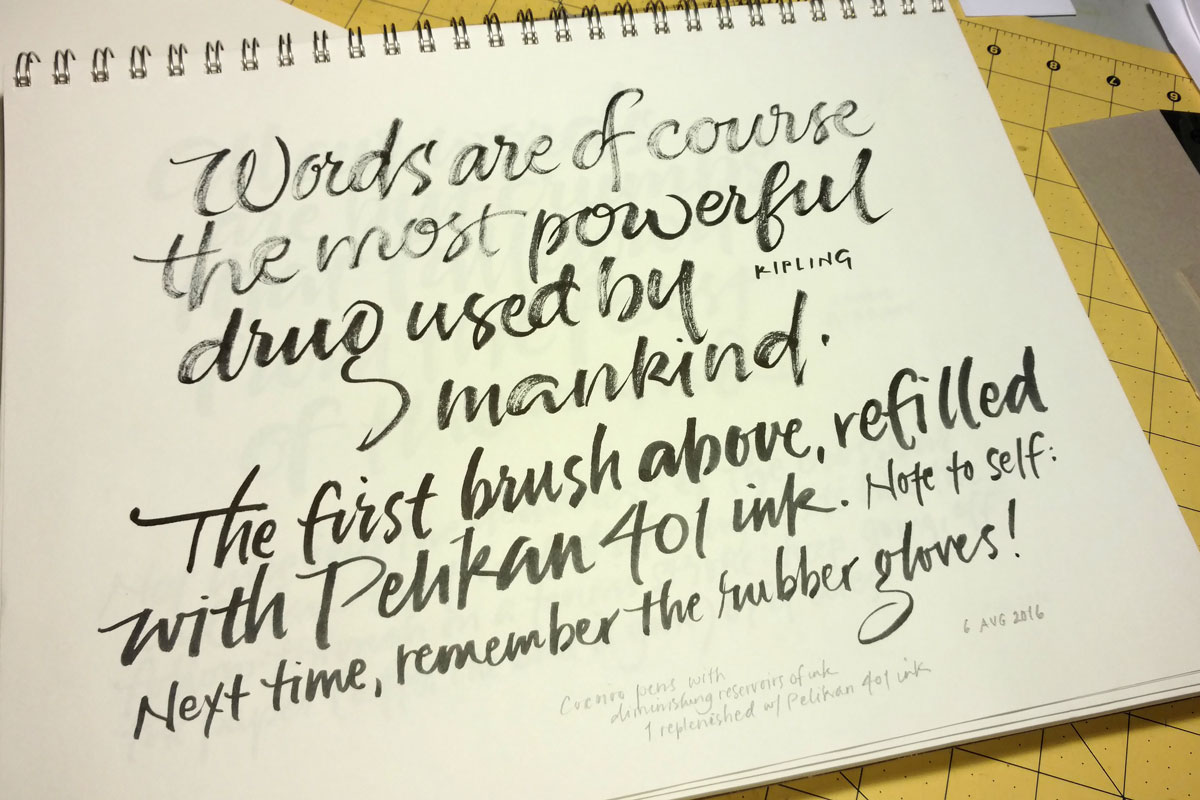
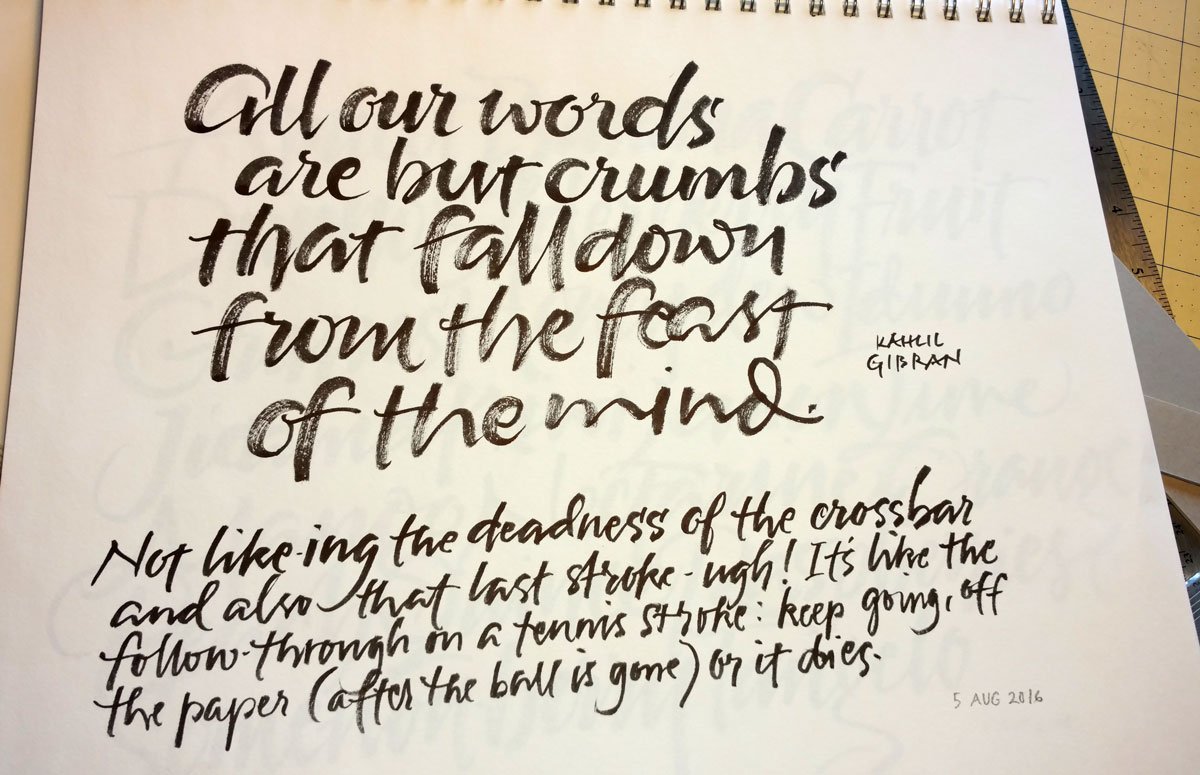
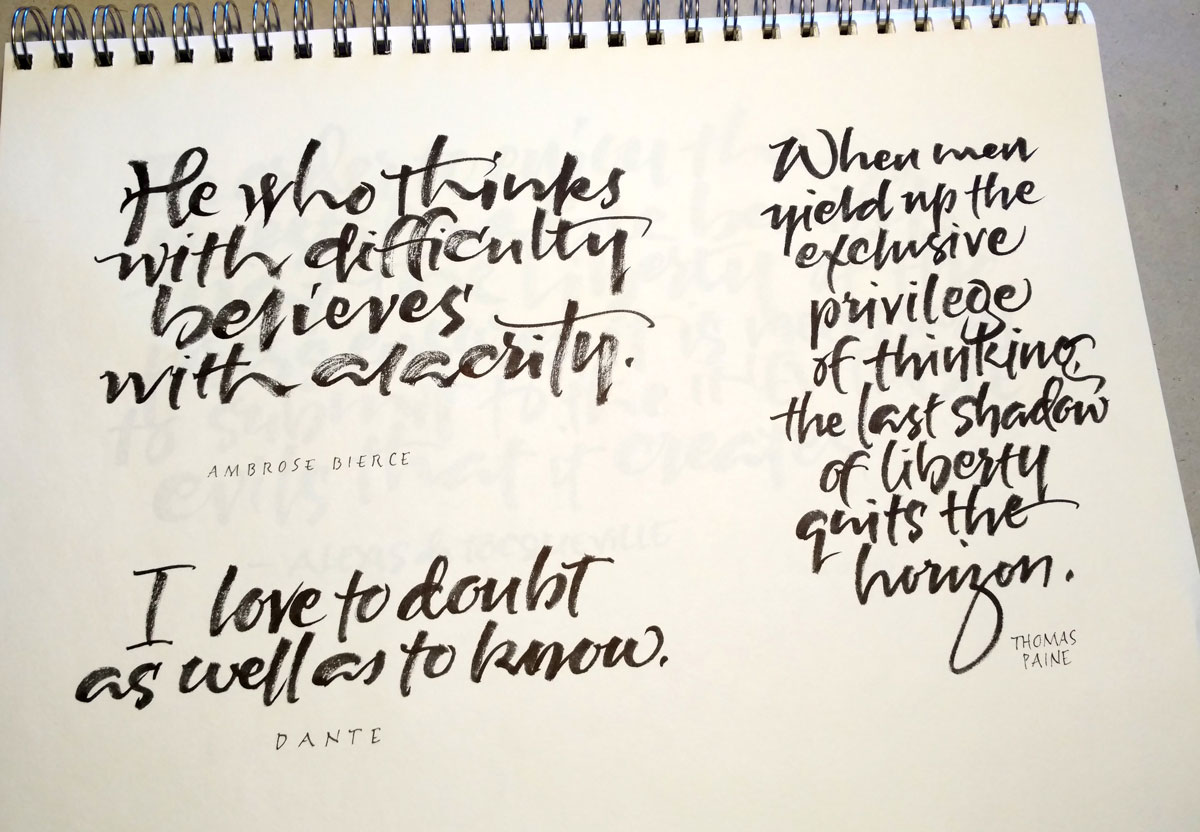
ZIG Cocoiro brush pens, the first pen losing ink, the second one with a full barrel of ink, and then the first one replenished with Pelikan 401 ink. On Strathmore Drawing 300, 11″ x 14″ pad.
I’m not making much progress with brush lettering, so this will be the last post of brush lettering for awhile. Still, I’ve enjoyed it but I don’t see that I’m accomplishing much. I’ll be thinking about that in the meantime.
One of the brush pens ran out of ink and I didn’t have a brush refill (having accidentally ordered the extra-fine tip, which is more like a flexible drawing point). So, using my jewelry-making-size pliers, I pulled off the brush tip … and the base of the brush tip … and the stem inside that … and the base that the stem fit into. Then I squirted some Pelian 401 ink into the barrel using a thick needle-less syringe that was perfect for the job. Then put it all back together and tried it out at the bottom of the page. Interesting. As I wrote, next time: remember to wear rubber gloves. My cuticles will thank me for it.
The usual suspects. Alphabets and really familiar texts are so much easier than other text because over time you get a kinetic sense of how the letters fit together.
—
When practicing, I try to be in the moment. But afterwards, it’s a good thing if the left brain kicks and tells me what’s good, what’s bad, what I need change next time. Otherwise, it’s just repetition, repetition, repetition.
“Contour drawing” using a page from one of Carl Rohrs’ workbooks. Cocoiro brush pen on Strathmore Drawing 300.
Today I returned a Carl Rohrs workbook that I had a borrowed from my friend Rose several (or more) months ago. Rose had been doing some brush lettering earlier, and we got to talking about the challenges of brush lettering, trying different tools, talking about that luscious dragging-the-bristles-around-the-arc thing that Carl does … the usual thing that happens when you’re standing in someone’s studio and there’s pen/brush, paper, and paint out on the table 🙂
Anyway, I kept thinking about it as I finished running errands. When I got back to my studio I opened up the Carl Rohrs workbook that I own and started copying a page of lettering he provided. I treated it like a contour drawing, not looking much at the paper but trying to feel the shape and speed and gesture of the letters. During some part of the exercise I realized that not even the letters were registering, much less the words, and I only later realized that some figures were Roman numerals, for instance. I like this kind of practice, and plan to continue it for at least a little while.
P.S. If you saw this side-by-side with the workbook page, you would probably be surprised at how little they resemble one another. For one thing, I skipped and duplicated and re-tried things as I went. For another, I didn’t duplicate the line leading, naturally crowding the leading as is my wont.
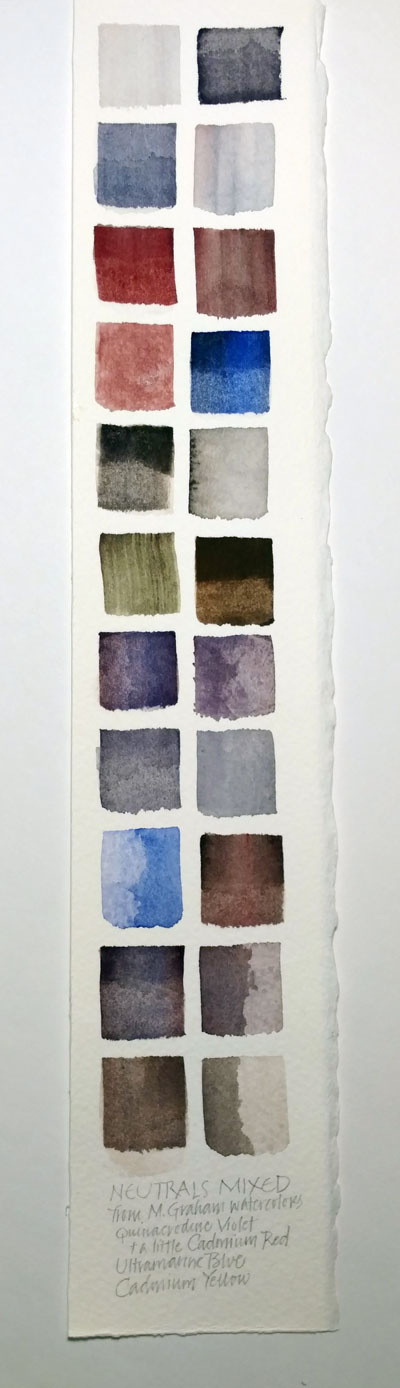
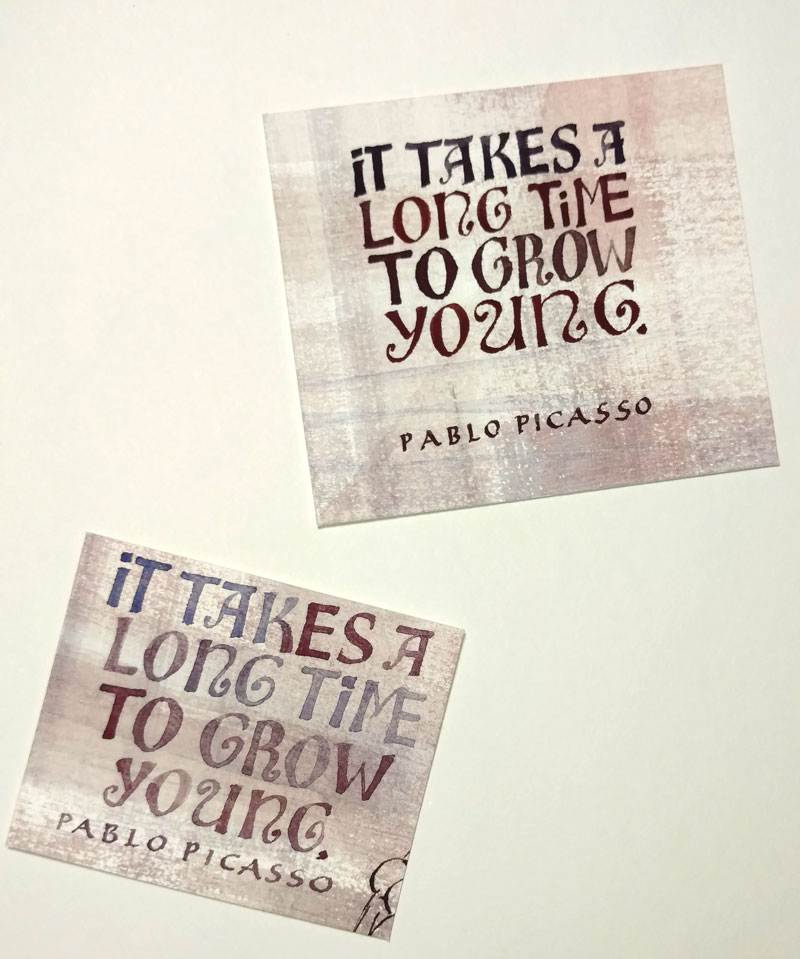
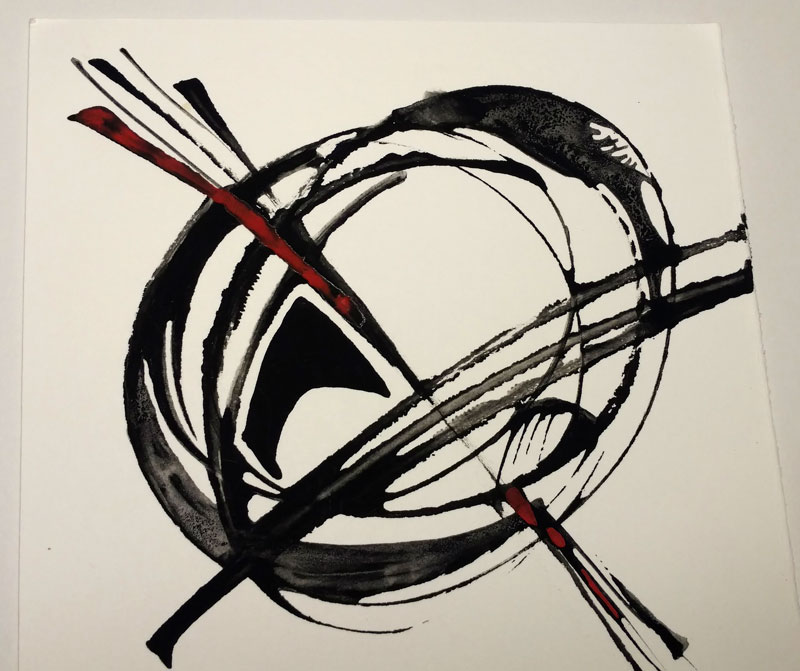
One of the really difficult parts about cleaning out my studio is figuring out what to do with all those bits of experiments that I’d like to develop further. A few cases in point:
Mixed neutrals, c. 2010Some color and painting studies. Judging by the use of the term “sequestration”, I’m guessing these were done October 2013.Some lettering for a few birthday cards. I guess these didn’t make the final cut. September 2013. Note the same colors as the previous bit, bearing out my date guess for that one.I think this was from 2010 as part of a series of logo marks. Further details are lost in the mists of time, but I seem recall something about mixing Jet Black gouache and sumi ink. Still, I like the liveliness of the lines.Walnut ink on drawing paper. Looks like I was probably processing what we had worked on in Rachel Yallop’s class at Legacies II conference in 2014.
And finally, in case you were wondering whether I’m still doing daily alphabets …
Coicoro brush pen on Strathmore Drawing 300 paper, 11″ x 14″.
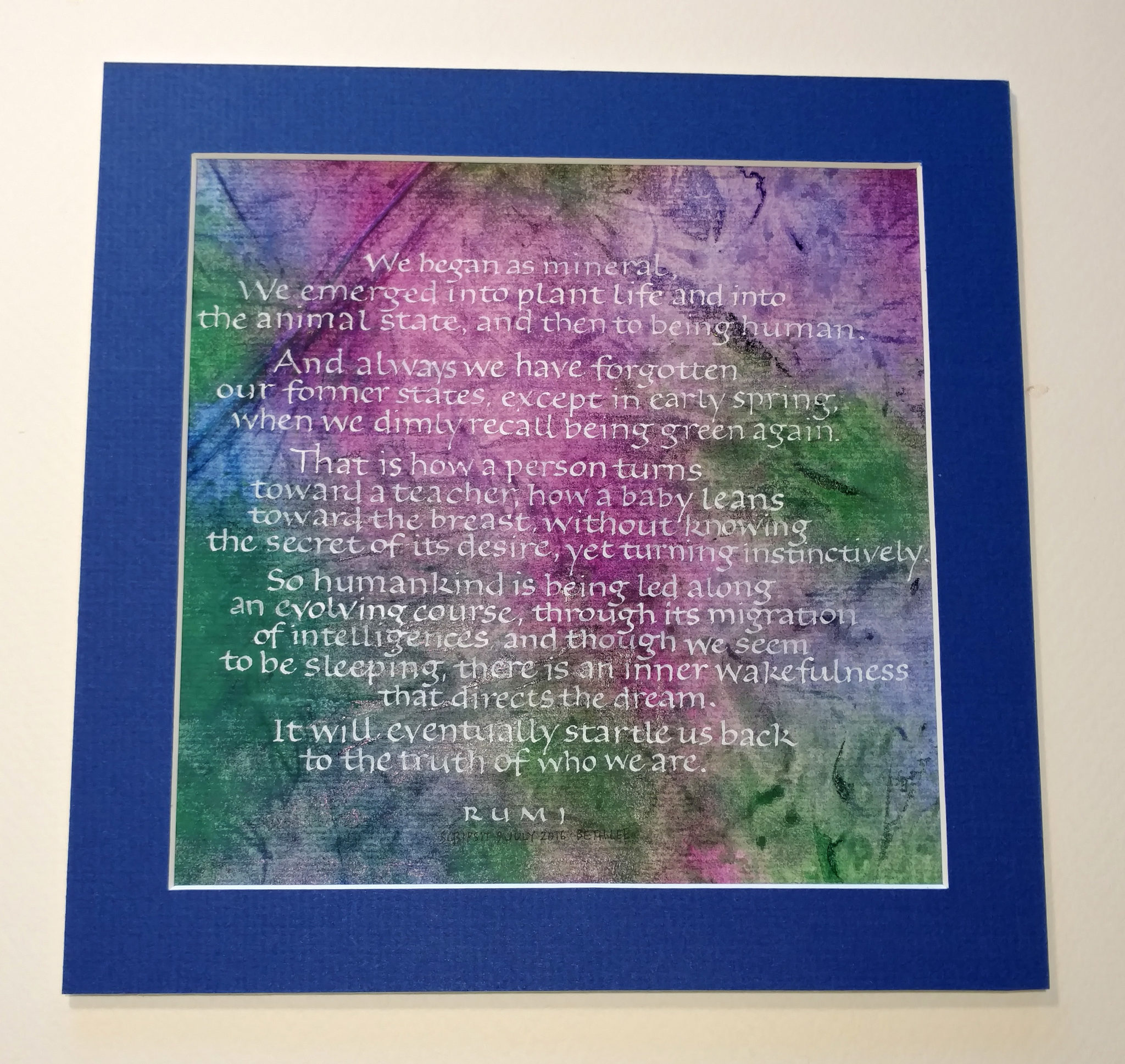
Mixture of white ink and Chinese white on paste-painted background. Matted size: 9″ square.
I dug out an old paste-painted paper that seemed appropriate for this Rumi poem. No planning, which left me with no margins. No guidelines, except that the paper is a laid paper. I like working without a net sometimes, and I decided to do this the same day I gave it, so it’s not like I had a choice, is it? The surface was somewhat plastic-y where the paint was thick, and therefore a little difficult to write on with a #4 Mitchell nib.
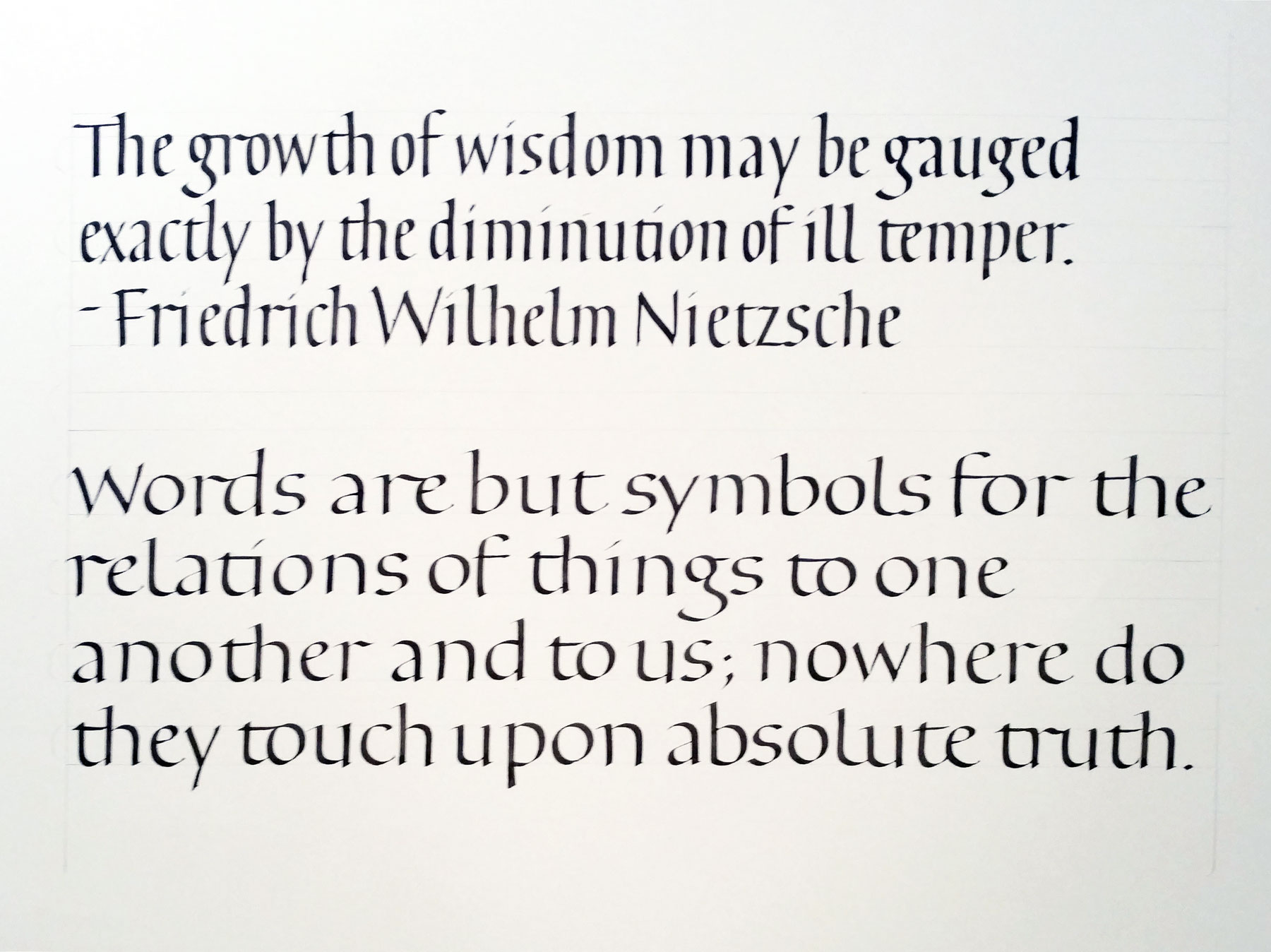
Bookhand variations using a Brause 2.5mm nib and Moon Palace ink on Strathmore Drawing 300 paper.
The bookhand homework
I always try to do the homework I’ve assigned. In this bookhand calligraphy class, part of the homework this week is to do work with the following specific intentions:
x-height of your choice, expressed in terms of pen-widths (between 3 and 5);
pen angle — your choice, but keep in mind that if you have few pen-widths in option 1, it will be natural to flatten your pen angle, and vice versa (between 15º and 40º);
compression — your choice, keeping “o” and “n” as touchstones;
letter spacing — partially a function of option 3;
ascender/descender size — should be partially a function of options 3 and 6; and,
line leading — partially a function of options 1 and 5, but also consider the size of your lettering in relation to the page, and also the length of your lines.
serif — simple lead-in, beak, slab, or nothing.
My choices for the bookhand variations
In the above 2 examples, my intentions were roughly as follows (I should have made notes — and let that be a lesson to you students!):
x-height is 4 pen-widths high in both cases, maybe a little more;
pen angle is 30-35º in both cases;
compression is roughly 2:1 (h:2) in the first sample, and 1:1.2 in the second sample;
letter spacing is necessarily tighter in the first sample than in the second;
ascender/descender height is the same for both, at about 2/3 the x-height; and,
line leading is the same in both cases, being simply the addition of the x-height + ascender height + descender height, with no additional space between upper descender and lower ascender.
the serif for first sample was beaked; for the second sample it was a simple lead-in.
It’s hard to switch from compressed to expanded without warming up. I also noticed that once I expanded the width of the letters I had to fight to keep the pen angle as steep as it had been for the compressed lettering.
Walnut ink and a Brause nib on Strathmore Writing 400.
Of all the major hands, I’m least confident about blackletter. This is copyfitting and practice for a personal project.
Contains information related to marketing campaigns of the user. These are shared with Google AdWords / Google Ads when the Google Ads and Google Analytics accounts are linked together.
90 days
__utma
ID used to identify users and sessions
2 years after last activity
__utmt
Used to monitor number of Google Analytics server requests
10 minutes
__utmb
Used to distinguish new sessions and visits. This cookie is set when the GA.js javascript library is loaded and there is no existing __utmb cookie. The cookie is updated every time data is sent to the Google Analytics server.
30 minutes after last activity
__utmc
Used only with old Urchin versions of Google Analytics and not with GA.js. Was used to distinguish between new sessions and visits at the end of a session.
End of session (browser)
__utmz
Contains information about the traffic source or campaign that directed user to the website. The cookie is set when the GA.js javascript is loaded and updated when data is sent to the Google Anaytics server
6 months after last activity
__utmv
Contains custom information set by the web developer via the _setCustomVar method in Google Analytics. This cookie is updated every time new data is sent to the Google Analytics server.
2 years after last activity
__utmx
Used to determine whether a user is included in an A / B or Multivariate test.
18 months
_ga
ID used to identify users
2 years
_gali
Used by Google Analytics to determine which links on a page are being clicked
30 seconds
_ga_
ID used to identify users
2 years
_gid
ID used to identify users for 24 hours after last activity
24 hours
_gat
Used to monitor number of Google Analytics server requests when using Google Tag Manager
1 minute
You can find more information in our Cookie Policy and .