Here’s something I’ve finished this morning. Since it won’t be presented for a couple of weeks, I’m only showing a sliver of it, and redacting identifying parts.
So I got it completed — on the second time time around, never mind what I did wrong on the first time around — but the names under the signature line ran a little long. No problem, I thought. I can just extend the signature lines. Then I realized that the extension ran into the space for the gold seal. This is the third time around.
Such are the minor idiocies of working under the influence of a major head cold. I’m assuming it’s a cold. After all, I had a flu shot this year, so it can’t be the flu. Right?
Yesterday I started a new journal for the new year. For many people, that means popping down to Borders for a $10 ready-made journal with ruled lines, and interesting cover, and a useful magnetic closure. (I love those magnetic closures.)
Evidently that would be too easy for me.
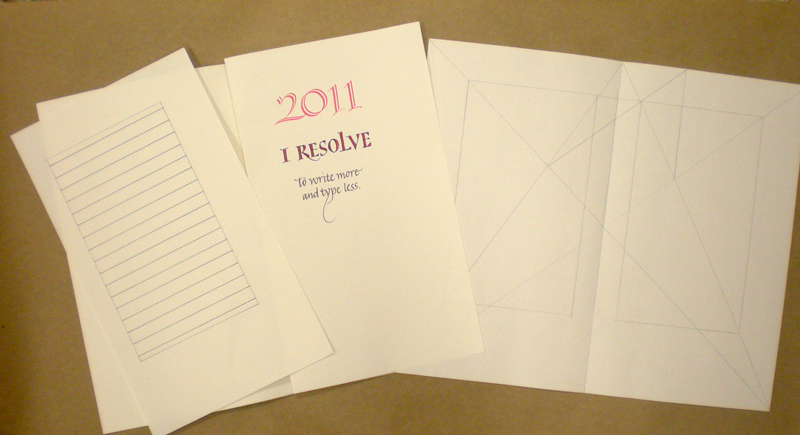
Instead I built my own, basing the page proportion on the golden ratio (1:0.6180339887), and the page layout on Rosarivo’s “divine proportion” and the van de Graaf canon of page construction, in turn based on medieval manuscript page design.
I’m using a pad of short-grain sketch paper, and I’ll bind it at the end of the year. Assuming I’m still writing in it by then. But of course I will be, right? It’s my new year’s resolution.
… my blog, that is. After years on Blogger — checking the archives, I see that it’s been a little over 5 years — I’ve moved this calligraphy blog to my calligraphy website. It may be a few days before I get the sidebar back in order, but the posts are all here. The old site was here but it now redirects to this blog, and you should be able to see all the old posts here.
Just a little thing, but fun to do. It’s a private little song the client sings to her grandchildren, so I haven’t reproduced that here, but I can show the little pink and purple flowers I added in the left margin.
Meanwhile, I’ve begun working on a much bigger, very exciting commission that I expect will take a good while to complete. I’ll be sharing bits and pieces, although not the commission itself, in future posts.
Using Adirondack alcohol inks and Martha’s blog posts as inspiration, I’ve just completed the last of the addresses in the annual envelope exchange … with a few extra envelopes for future purposes.
The 2nd photo shows the envelopes before they were addresses, and the stencil I used. Actually, I hated the addressing job I did on the bottom envelope, so I trashed it, made another round of stenciled envelopes and started again.
Just finished a commission for an accordion book. I thought I understood what the client wanted, but you know, every once in a while I just get it wrong.
I heard:
Stained glass but not religious (which I suggested would be difficult).
Masculine.
Traditional.
Muted colors.
Well, I’m not good with muted colors; this first attempt is muted colors … for me.
What I didn’t understand was the particular meaning of traditional. Looking at this first attempt I now realize that this looks like a particular style of my Presbyterian youth. My mother had jewelry that looks like this, and I was clueless about that connection while designing the book.
So I started over again with a style that the client had liked in the past. And I realize that even though it doesn’t have muted colors and it doesn’t seem very masculine to me, it is more traditional — in both a catholic and Catholic sense.
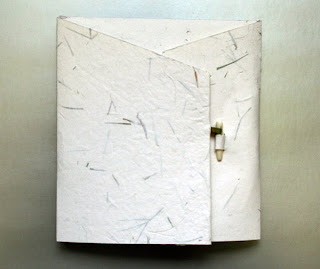
The cover is a green silk bookcloth shot through with gold. I think it works. I made a wrapper from handmade paper with leaf inclusions, using a strip of book cloth as the ribbon holding the bone clasp.
Making a case-bound book — Very thorough and well illustrated. This tutorial is geared toward making a blank book from large parent sheets of paper. If you’ve already got your signatures cut, you can jump in at step 2, about 13 screens down the road.
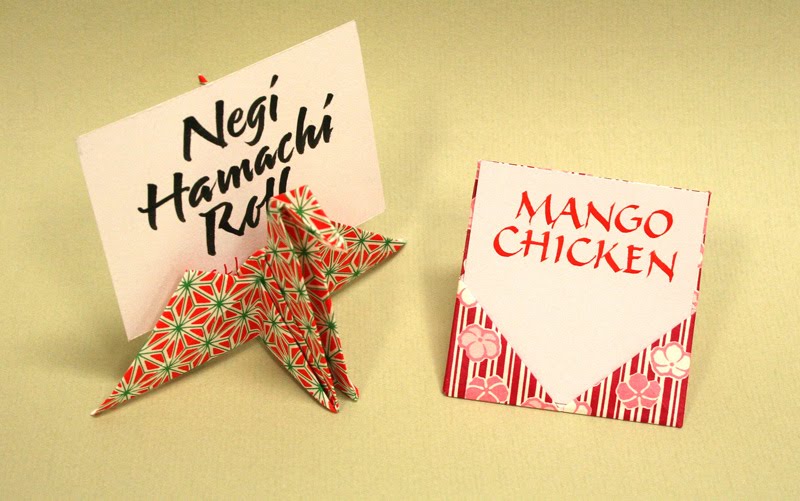
Last month I did some table cards to identify the food at a reception featuring Japanese and Chinese cuisine. I meant to take some photos before I let them go, but, as often happens, I forgot. So I was cleaning up the studio today and came across the remains of the project. These rejects show the Japanese and Chinese cards, respectively.
Contains information related to marketing campaigns of the user. These are shared with Google AdWords / Google Ads when the Google Ads and Google Analytics accounts are linked together.
90 days
__utma
ID used to identify users and sessions
2 years after last activity
__utmt
Used to monitor number of Google Analytics server requests
10 minutes
__utmb
Used to distinguish new sessions and visits. This cookie is set when the GA.js javascript library is loaded and there is no existing __utmb cookie. The cookie is updated every time data is sent to the Google Analytics server.
30 minutes after last activity
__utmc
Used only with old Urchin versions of Google Analytics and not with GA.js. Was used to distinguish between new sessions and visits at the end of a session.
End of session (browser)
__utmz
Contains information about the traffic source or campaign that directed user to the website. The cookie is set when the GA.js javascript is loaded and updated when data is sent to the Google Anaytics server
6 months after last activity
__utmv
Contains custom information set by the web developer via the _setCustomVar method in Google Analytics. This cookie is updated every time new data is sent to the Google Analytics server.
2 years after last activity
__utmx
Used to determine whether a user is included in an A / B or Multivariate test.
18 months
_ga
ID used to identify users
2 years
_gali
Used by Google Analytics to determine which links on a page are being clicked
30 seconds
_ga_
ID used to identify users
2 years
_gid
ID used to identify users for 24 hours after last activity
24 hours
_gat
Used to monitor number of Google Analytics server requests when using Google Tag Manager
1 minute
You can find more information in our Cookie Policy and .



 I heard: